 Industrial Automation branch INA
Why do you benefit from COMETH?
Preparing large, unlabeled data sets for intelligent algorithms is particularly labor-intensive. With changing conditions and often insufficient data, the question arises as to how to avoid failures and detect anomalies at an early stage. COMETH offers the solution, even for initially unannotated data and inexperienced personnel. Even under unpredictable conditions, COMETH detects deviations and enables preventive maintenance. COMETH lays the foundation for new services and business models for plant/machine manufacturers and operators.
How does COMETH operate?
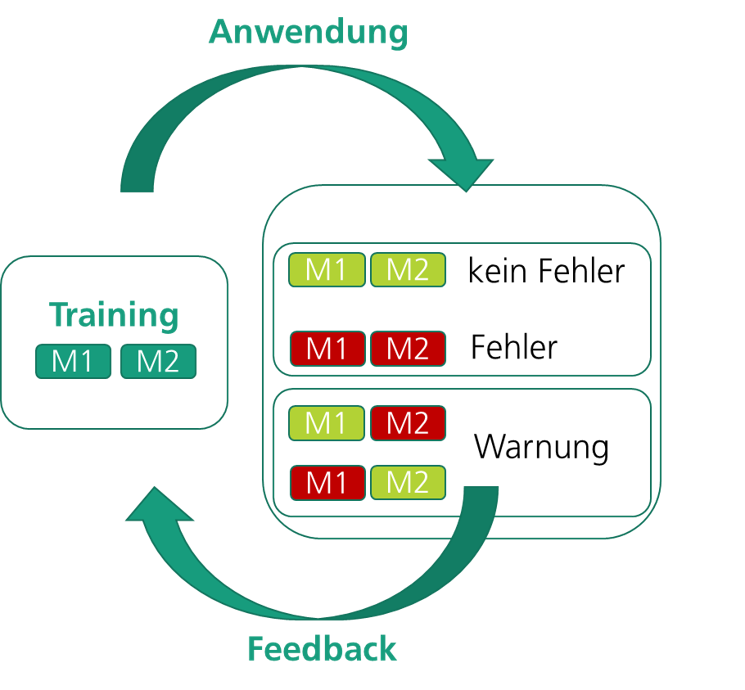
COMETH combines two complementary machine learning methods—one with high sensitivity (i.e., few false negatives) and one with high specificity (i.e., few false positives)—to detect anomalies as efficiently as possible. Both methods are used in parallel: if there are differences in classification, user feedback is obtained and the two methods enter the next training cycle. The need for feedback decreases as performance increases.
How does COMETH support users?
COMETH not only detects anomalies, but also provides precise information about possible causes. The results are displayed in a user-friendly graphical interface (GUI), which also serves as a feedback input. This makes it easy to monitor the condition of the plant, document troubleshooting measures, and minimize downtime. With COMETH, companies can maximize the efficiency of their plants, reduce the risk of failure, and improve overall performance.
Target industries:
• Metalworking
• Coating processes
• Assembly processes
• Image analysis for reject detection
Example project:
• Herbert Kannegiesser GmbH:
Anomaly detection on a laundry separation system