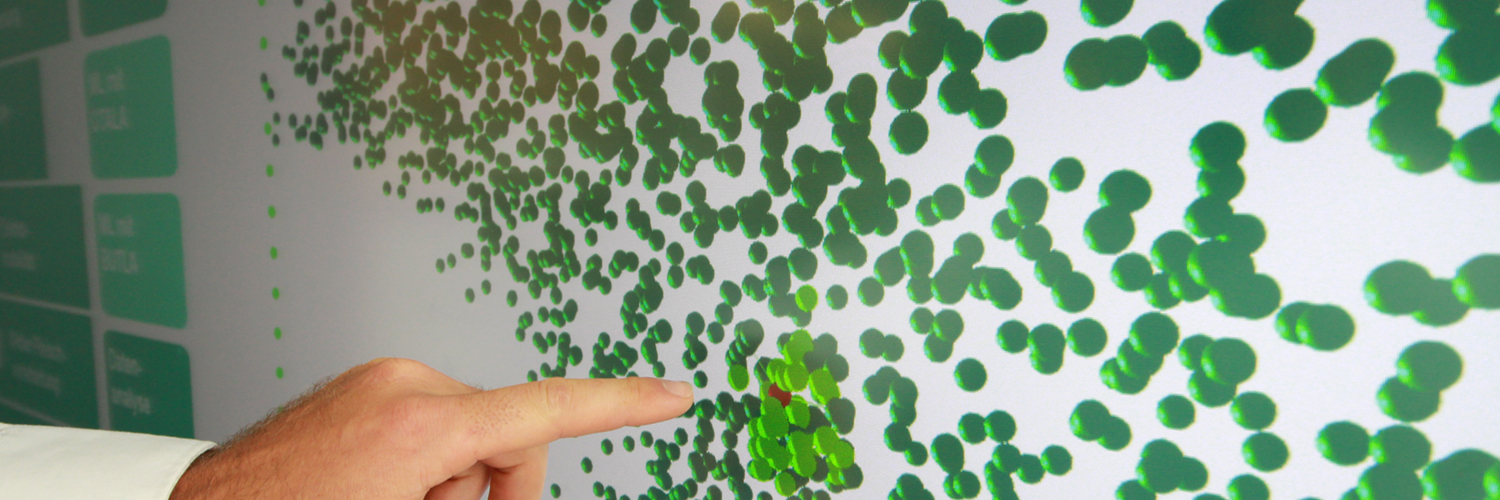
Machine Learning

Achieving added value in production through intelligent data analysis.

The Machine Learning working group supports you in analyzing existing data, works with you to develop a strategy for the automated collection or generation of suitable training data and the introduction of data analysis methods, and delivers tailor-made solutions for your challenges.
Monitoring, diagnostics, predictive maintenance, and optimization are key challenges in the operation of technical systems. Valuable information on wear, causes of faults, and optimization potential is contained in the process data of machines and systems. However, this information often remains unused today because the relevant measurement data is not recorded or the data is not analyzed systematically.

That is why we develop solutions for the automated collection, linking, management, visualization, and analysis of large amounts of industrial data. We use innovative methods to integrate expert knowledge, data enrichment, and interpretation of documents and images in order to best map your use case.

Our innovative methods:

• Data generation/augmentation

• Physics-informed machine learning

• Efficient label generation

• Large language models

• Smart visualization

Further Information

Research topics and projects

job offers

Research assistant in the field of AI (LLM's)

  • The Fraunhofer Institute in Lemgo and the Department of Economics at the Ostwestfalen-Lippe University of Applied Sciences (THOWL) have founded a new research area at the Innovation Campus in Lemgo. The focus is on the development of new business models based on added values that lie in the product and production data of primarily medium-sized companies. Data-based value chains are becoming increasingly important because more and more data is being generated in automated industrial production environments. To enable medium-sized companies in particular to generate more value from this data in the future - for example, with the help of artificial intelligence (AI) and via new business models - Fraunhofer and TH OWL are combining the perspective of economics with more than ten years of expertise in intelligent automation.

    more info
  • (Lemgo) Now that developers at Stührenberg GmbH and Fraunhofer researchers from Lemgo have already worked on intelligent traffic signal systems (LSA), the next step follows: Starting in October 2021, the project partners will also bring artificial intelligence (AI) to traffic signals for pedestrian crossing. The research questions here are aimed at reducing waiting times, increasing safety and showing consideration for vulnerable people. This is made possible by the Federal Ministry of Transport and Digital Infrastructure (BMVI:) In the "KI4PED" project, an innovative approach to demand-oriented control for pedestrian traffic lights is to be developed. As with the predecessor project for car traffic, if the technology can be applied to a real traffic situation, the potential is enormous if scaled up. The project will initially run until July 2022 and is being funded by the BMVI with a total of 95,566 euros as part of the mFUND innovation initiative.

    more info